

How applying the same level of scrutiny to every lead can quietly increase costs, strain operations, and reduce profitability.
Imagine you’re buying 100,000 leads per month.
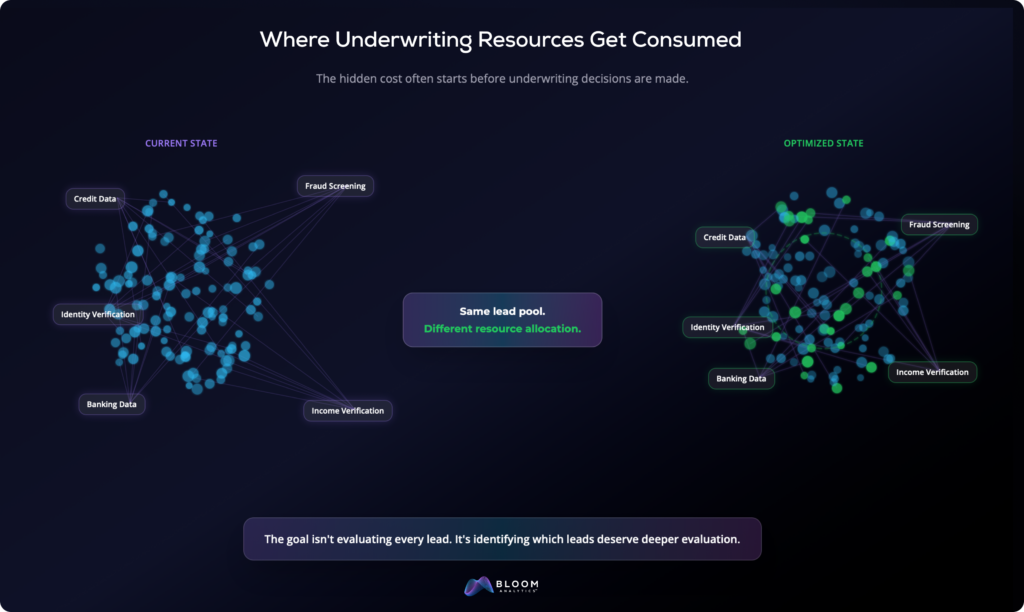
Your underwriting team wants the best possible decisions, so every application gets the full treatment: credit data, fraud tools, identity verification, income verification, and bank transaction data.
The logic seems sound. More information should lead to better decisions.
But six months later, something feels off.
Data costs keep rising. Underwriting workloads keep growing. And despite evaluating every lead with the same rigor, portfolio performance is not improving enough to justify the expense.
What is happening?
In many cases, the problem is not underwriting quality. It is that too much effort is being spent evaluating leads that were never likely to become profitable customers in the first place.
Every lead source contains a tail.
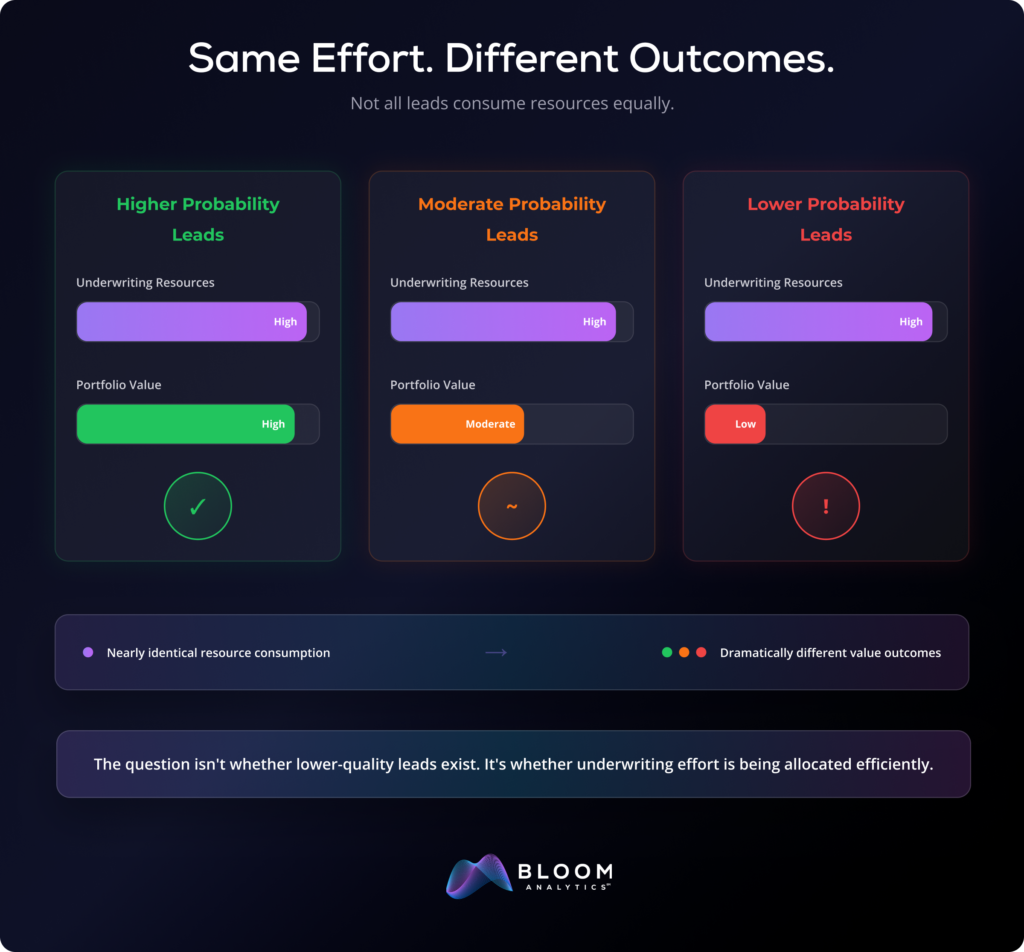
Some applicants are highly likely to qualify and perform well. Some sit somewhere in the middle. And some have a much lower probability of approval, funding, or successful repayment.
Yet many lenders apply the same expensive evaluation process across the entire population.
The result is a hidden form of operational waste. Expensive data gets pulled on applicants who are unlikely to convert. Underwriting resources get consumed by low-probability applications, creating workflow strain that compounds over time.
The Cost of Chasing the Tail
One of the most overlooked drivers of underwriting expense is what happens at the bottom of the funnel.
Not the funded borrowers. Not even the declined borrowers.
The applications that had a low probability of creating portfolio value in the first place.
Think of it this way: if 20% of your incoming traffic ultimately drives most of your approvals, repayments, and profitability, does it make sense to spend the same amount evaluating the other 80%?
For many lenders, the answer is no.
Yet that is exactly what can happen when every lead receives the same underwriting treatment. The goal becomes gathering as much information as possible rather than determining whether the application deserves deeper evaluation in the first place.
That is an expensive mistake.
A Better Way to Allocate Underwriting Resources
The strongest lending operations do not necessarily use less data. They use it more strategically.
Instead of sending every application through the same evaluation path, they prioritize. Lower-cost signals can help identify obvious risk earlier, while internal scoring models can separate stronger applicants from weaker ones.
Only then does it make sense to invest in more expensive underwriting tools and third-party data.
This does not mean cutting corners or excluding applicants arbitrarily. It means using compliant, validated, and stage-appropriate signals to determine when deeper underwriting review and third-party data expense are warranted.
The result is a smaller pool of applications receiving deeper analysis. More importantly, it is a more relevant pool.
And that distinction matters.
Because the objective is not necessarily eliminating data costs altogether. It is reducing wasted data costs.
Likewise, the goal is not reducing underwriting effort. It is focusing underwriting effort where it has the highest probability of generating returns.
The Bigger Impact on Financing Economics
When lenders reduce unnecessary evaluation activity, the benefits often extend far beyond data spend.
Decisioning becomes faster. Operational workloads decrease. Vendor expenses become easier to manage. Teams spend less time reviewing low-probability applications and more time focusing on opportunities that matter.
Most importantly, cost-per-funded-loan often improves because resources are being allocated more efficiently across the financing lifecycle.
That is why mature lending organizations increasingly think about underwriting as a resource allocation problem, not simply a risk assessment problem.
The question is no longer:
“How do we evaluate every lead?”
It’s:
“How do we identify which leads deserve the most evaluation?”
Reassess Where Underwriting Effort Is Being Spent
At Bloom Analytics, we help lenders identify where underwriting resources, third-party data spend, and operational effort may be misaligned with actual portfolio value.
If rising evaluation costs are putting pressure on your financing economics, it may be time to reassess where underwriting effort is being spent.
Book a strategy call to identify where underwriting effort, third-party data spend, and operational resources may be misaligned with actual portfolio value.