

Finding quality leads at the top of the lending waterfall can feel a lot like looking for needles in a haystack.
Except this haystack can contain tens of thousands of leads. And every minute, dollar and data pull spent digging through it adds to the cost of finding the ones you actually want.
What if you could shrink the haystack first?
That’s one of the most useful ways to think about predictive lead scoring.
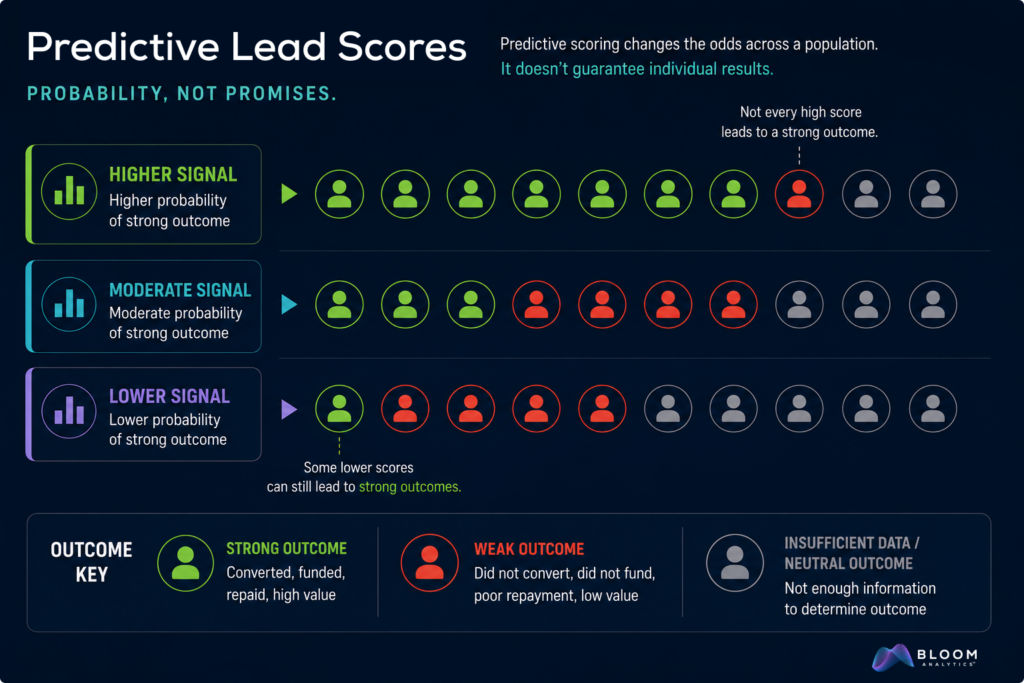
The goal isn’t to point to one lead and declare, “There’s your needle.” Predictive lead scoring can’t guarantee how an individual lead will behave.
What it can do is identify patterns across large volumes of traffic to help lenders distinguish between stronger and weaker groups of leads. That gives lenders another signal for deciding where to focus acquisition dollars, data spend and underwriting resources.
It’s a subtle distinction, but an important one.
Predictive scoring deals in probabilities, not promises
Predictive lead scoring works by finding patterns in data.
Depending on what a model is designed to evaluate, it might identify signals associated with conversion, approval and funding, repayment performance or even the potential economic value of different lead traffic.
But a higher probability is still just that: a probability.
A lead with a strong score can perform poorly. A lower-scoring lead can ultimately become a great customer.
That’s not necessarily evidence that the model got it “wrong.” It’s what happens when population-level insights get interpreted as individual guarantees.
Think about a weather forecast.
A 70% chance of rain doesn’t guarantee that a drop will hit your roof. And sunshine over your house doesn’t automatically make the forecast useless.
The information matters because it helps you make a more informed decision about what to do next.
Predictive lead scoring operates on a similar principle.
Instead of asking:
“Can you tell me exactly what this applicant is going to do?”
A better question is:
“Can you help me decide where to focus my resources across thousands of incoming leads?”
Now we’re asking predictive analytics to do the job it’s actually good at.
So, what does predictive lead scoring actually evaluate?
That depends on the model.
One model might look for patterns associated with whether leads eventually make it through underwriting and fund. Another might evaluate conversion potential among approved leads. Others can identify signals related to repayment or estimate potential lead value.
And some of the patterns models identify aren’t necessarily things a human reviewing individual applications would spot.
Two applications could look remarkably similar at first glance and still score differently.
Why?
Lead source may matter. Timing may matter. In some circumstances, even the time of day an application arrives can carry information when considered alongside other variables.
No single one of those factors declares a lead “good” or “bad.”
The power comes from finding relationships among many data points across very large populations and using those patterns to better understand incoming traffic.
That’s also why predictive lead scoring becomes particularly interesting at scale.
If you’re processing 50 leads, shrinking the haystack may not fundamentally change your operation.
If you’re processing 50,000, it can be a very different conversation.
What doesn’t it tell you?
Here’s where expectations matter.
Predictive lead scoring does not tell you with certainty that a particular applicant will convert, fund, repay or meet your credit criteria.
It also shouldn’t be used to independently determine whether an individual should receive credit.
Lead quality scoring happens earlier.
Its job is to help you make decisions about incoming lead traffic: what looks promising, what looks particularly weak and where additional investment may be warranted.
That’s different from determining whether an individual applicant ultimately qualifies for a loan.
Which brings us to something worth stating plainly.
You still need underwriting
Predictive lead scoring isn’t a replacement for underwriting.
Nor does it make credit bureau data, verification information or other third-party resources irrelevant.
Those tools can provide information a top-of-waterfall lead scoring model doesn’t have, and they play different roles in the lending process.
The opportunity is in being more intentional about where you deploy them.
If you receive 50,000 leads but have limited resources, predictive scoring can provide another signal for determining which portions of that traffic should continue through deeper evaluation.
Where you draw that line depends on your volume goals, resources, economics and risk tolerance.
Predictive analytics doesn’t make that decision for you.
It gives you more information to make it.
Or, put another way:
Use predictive scoring to make a better next decision, not the final one.
What if you could start with a smaller haystack?
If you’re buying and processing leads at scale, you don’t need predictive scoring to make your lending decisions for you.
You need better information earlier.
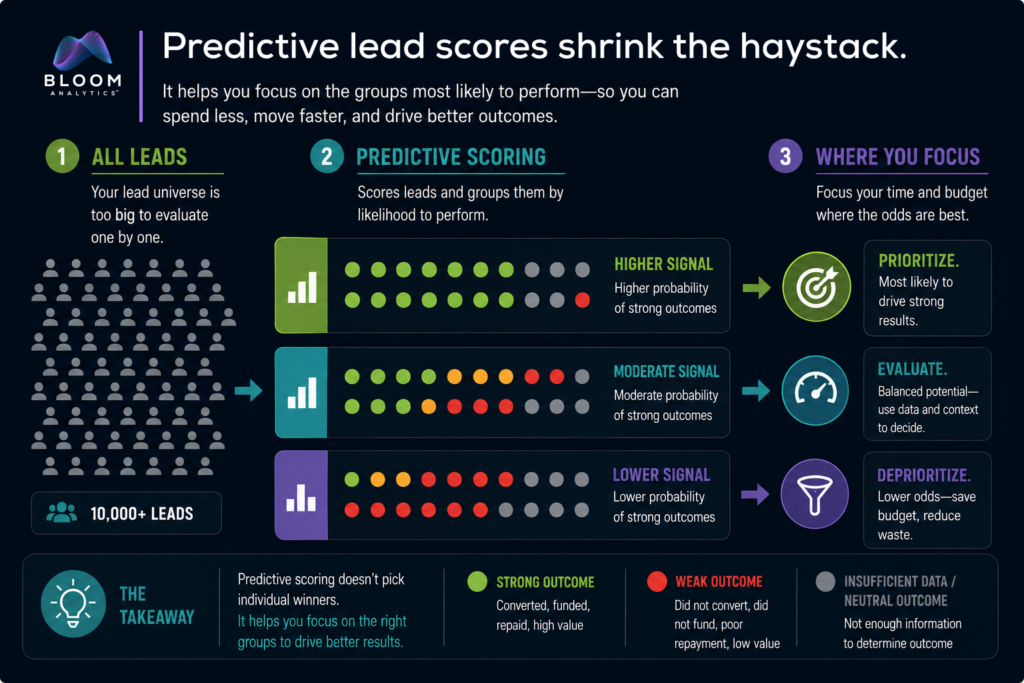
That’s what we designed BloomGrade℠ to provide.
BloomGrade uses the application data already coming into your system to identify lead-quality signals before you commit additional resources to full underwriting. Depending on what you need to understand, Bloom scores can help you evaluate signals associated with approval and funding, conversion, repayment and potential lead value.
The goal is simple: help you make smarter decisions about the traffic in front of you.
Maybe that means identifying portions of incoming traffic that are more likely to consume resources without producing the volume or performance you’re looking for. Maybe it’s deciding which leads warrant deeper evaluation. Or maybe it’s understanding enough about the potential value of your lead traffic to make a more informed decision about what you’re willing to pay for it.
What BloomGrade won’t do is make your lending decisions for you.
Your underwriting process, risk tolerance, volume goals and economics still determine what happens next. BloomGrade gives you another layer of intelligence to bring to those decisions.
Because when 50,000 leads are coming through the door, finding every needle with perfect certainty isn’t the realistic goal.
Starting with less hay is.
Explore BloomGrade for smarter lead prioritization
See how BloomGrade can help you evaluate lead quality earlier and focus your resources on the traffic most worth a closer look.
Disclaimer: BloomGrade provides predictive analytics based on historical and current data patterns. Scores are intended to support lead evaluation and business decision-making and should not be used as the sole basis for credit, underwriting, or adverse action decisions. Results are not guaranteed and may vary.